
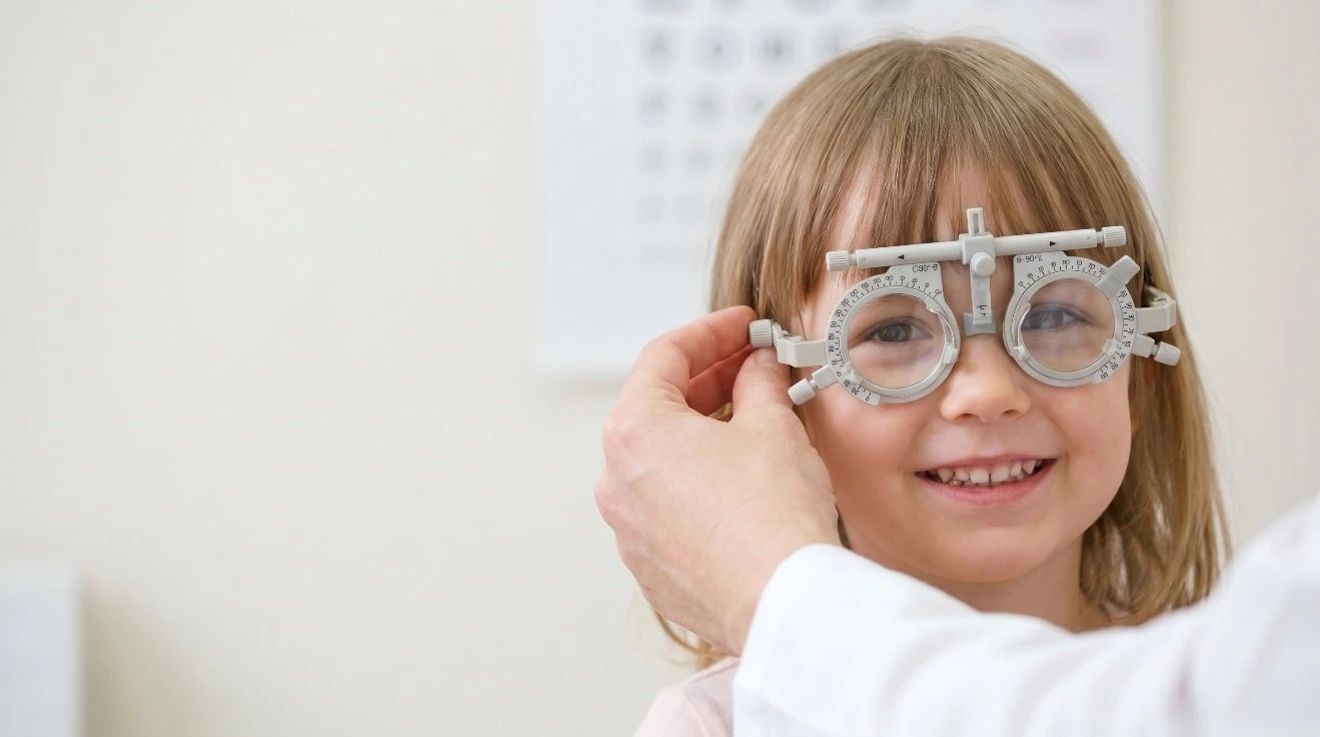
Most parents know when to schedule vaccinations and dental visits, but many aren’t sure when their child should have their first eye exam. A child’s first comprehensive eye exam should take place between 6 and 12 months of age, followed by annual eye exams from age 1 through 19. In this guide, we’ll explain when your child needs eye exams, what happens during a pediatric eye exam, and what Ontario’s OHIP coverage includes.
Key Takeaways
Understanding when and why your child needs eye exams is crucial for their development and academic success. Here’s what every parent should know about when their child should get their first pediatric eye exam:
- Most pediatric vision problems show no obvious symptoms, which is why first eye exam matters.
- Schedule your child’s first comprehensive eye exam between 6 and 12 months of age, then annually from age 1 through 19. Early detection supports healthy visual development.
- OHIP fully covers the basic annual eye exam for children and youth aged 19 and under. Some additional tests and services, including Optomap imaging and contact lens fittings, are not covered and may involve out-of-pocket costs.
- Watch for behavioral warning signs like frequent squinting, sitting close to screens, avoiding reading, or complaints of headaches—children rarely voice vision problems directly.
- Vision problems directly impact school performance and can be misdiagnosed as learning disabilities—undetected issues affect reading comprehension, focus, and hand-eye coordination.
- Early detection of conditions like amblyopia (lazy eye) is essential, as treatment becomes nearly impossible after age 7-8 when the visual system fully develops.
- A regular eye exam can help protect your child’s sight and support healthy development and school readiness.
When Should Children Get Their Eyes Checked?
At Rideau Optometric, many parents are surprised to learn their child’s first comprehensive eye exam should happen before their first birthday. Because many childhood vision problems develop without obvious warning signs, early eye exams are one of the best ways to support healthy visual development and detect issues before they affect learning or daily activities.
Newborn to 6 months: initial screening
Your newborn should receive a basic eye health check right after birth. A doctor or health professional will test for a red reflex (similar to red eyes in flash photos) and check blink and pupil responses. This initial screening catches serious eye health issues early.
Between birth and six months, your baby’s visual system develops rapidly. At birth, they see only blurred patterns of light and dark. By four months, color vision becomes similar to an adult’s, and by six months, they develop eye movement control and hand-eye coordination. If your infant’s eyes appear significantly crossed or remain misaligned after six months, contact an optometrist right away.
Ages 6-12 months: first comprehensive pediatric eye exam
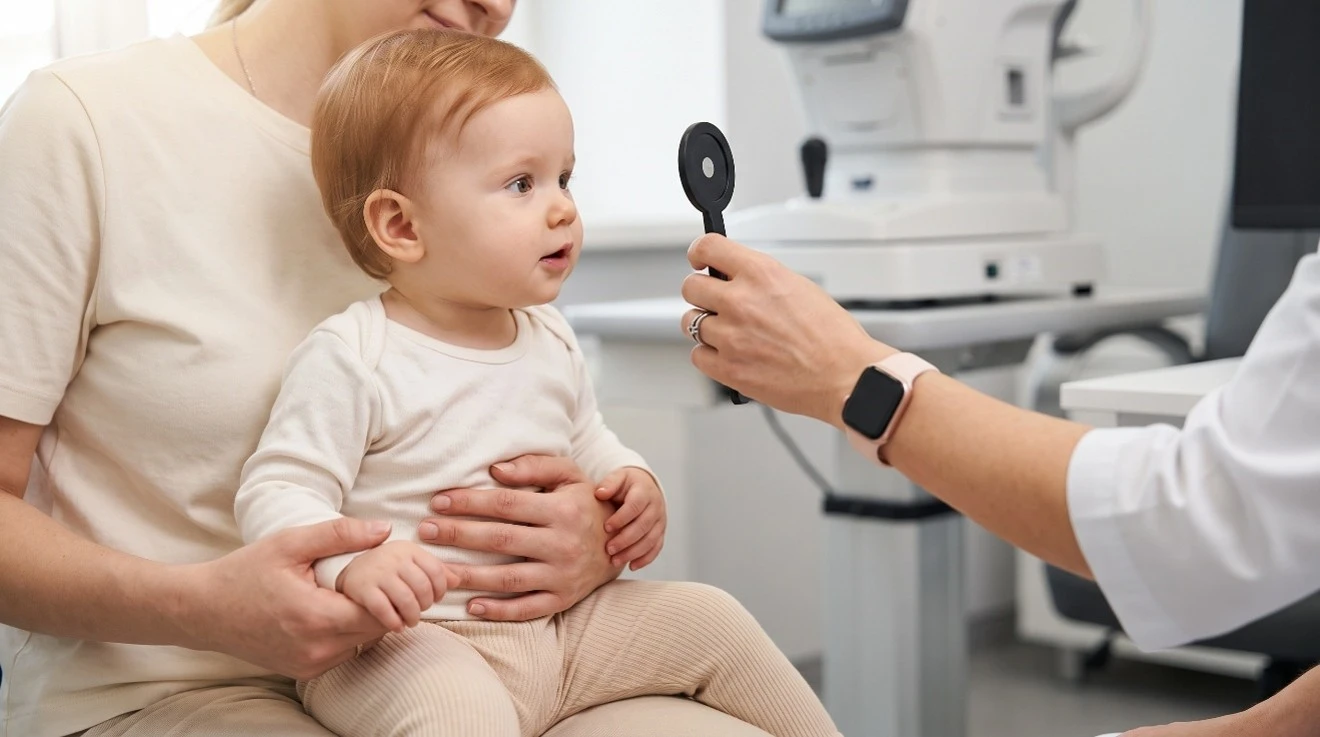
Your baby should receive their first comprehensive infant eye exam between 6 and 12 months of age. This exam checks for nearsightedness, farsightedness, astigmatism, eye movement ability, and eye alignment. The optometrist also looks for amblyopia (lazy eye), which is important to identify early so treatment can begin when it is most effective.
Ages 1-5: preschool vision assessment
After the first comprehensive exam, children should continue having annual eye exams starting at age 1. During the toddler and preschool years, regular exams help monitor visual development and detect potential vision problems before school starts. Children may not recognize or report difficulties, and some vision problems can affect reading, attention, and other everyday activities.
Ages 6–19: Annual eye exams through school age and adolescence
Annual eye exams remain important throughout the school years and teenage years. Vision can change as children grow, while classroom activities, reading, screen use, and sports place different demands on their vision. Regular eye exams help identify changes in vision and support children’s visual needs at school, during sports, and in everyday life.
In one Canadian study, myopia (nearsightedness) increased from 6% among children aged 6 to 8 to nearly 29% among those aged 11 to 13. Despite the importance of early eye care, only about 14% of Canadian children have a comprehensive eye exam before age 6. Scheduling regular exams from infancy onward helps parents stay ahead of potential vision concerns.
Warning Signs Your Child Needs an Eye Exam
Children rarely complain about vision problems because they assume everyone sees the same way they do. Parents need to watch for behavioral clues instead. These warning signs often appear subtle at first, but recognizing them early can make a significant difference in your child’s development.
Frequent eye rubbing or squinting
Eye rubbing when your child isn’t tired signals potential vision trouble. Frequent blinking and rubbing usually points to irritation from allergies, but it can also indicate a refractive error like nearsightedness. Squinting when the light isn’t bright or scrunching up their face during tasks suggests your child struggles to see clearly. Watch for these patterns during homework, reading, or screen time.
Sitting too close to screens or holding books very close
When your child sits very close to the TV or holds books near their face, this behavior often indicates they’re already nearsighted. Specifically, moving closer to screens or books can signal developing myopia. Parents sometimes dismiss this as a bad habit, but it’s your child’s way of compensating for blurry distance vision.
Difficulty in school or avoiding reading
Smart, curious children who fall behind in class may have vision problems rather than attention issues. If your child avoids reading, skips lines of text, or frequently rereads the same sentence, they might be experiencing visual fatigue from uncorrected focusing issues. Watch for your kids if they show signs of daydreaming during work time, have a short attention span during near tasks, or persistently reverse letters and numbers. Reading avoidance isn’t always about motivation.
Poor hand-eye coordination
Vision problems affect how the brain, eyes, and body communicate. Children with poor hand-eye coordination may struggle to catch or throw balls, have messy handwriting with inconsistent spacing, or frequently knock over drinks and drop objects. Moreover, some children avoid sports or physical activities where their difficulties become visible. Perception is mostly visual, so if your child must exert extra effort to process visual information, less mental energy remains for motor tasks.
Complaints of headaches or eye strain
Headaches that appear after reading, homework, or device use point to vision issues. Your child might complain of blurry or double vision, tired eyes, or eye pain. These physical symptoms show up during or after activities requiring sustained focus. Red, itchy, or burning eyes alongside headaches warrant a pediatric eye exam.
Eyes appearing misaligned or crossed
You may notice your child’s eyes look in different directions at the same time. Strabismus shows up when children close one eye, tilt their head when looking at objects, or turn their head to focus. About 30% of children with strabismus have a family member with the same problem. Most strabismus appears by age 3, though newborns normally have crossed or wandering eyes until 3 to 4 months. The sudden appearance of crossed eyes in an older child requires immediate attention.
What Happens During a Child’s First Eye Exam
Walking into your child’s first eye exam doesn’t require any preparation beyond showing up. The pediatric eye exam procedure is designed specifically for children who can’t read letters or communicate clearly about their vision.
What to expect: pediatric eye exam procedure
A pediatric eye exam happens in two parts. Prior to any testing, the optometrist will discuss your child’s health history with you. This conversation covers prenatal and postnatal history, family eye problems, any vision screenings your child has had, medications, developmental milestones, and school performance. Your optometrist also wants to know about frequent eye rubbing, difficulty maintaining eye contact, or poor tracking skills. For instance, mentioning that your child failed a school vision screening helps the doctor know what to watch for.
Tests for infants (6-12 months)
Infant eye exams work for babies with no ability to identify letters or pictures. Your baby can sit on your lap during the exam. The optometrist checks three main areas:
- Pupil responses test measures how your baby’s pupils open and close in different lighting pupil responses.
- Fixate and follow tests measure whether your baby can track a moving toy or light, with fixation developing within the first month and following by three months.
- Preferential looking test uses striped cards next to gray cards to measure visual acuity, as babies naturally look at the more interesting striped pattern.
Eye tests for toddlers and preschoolers (2-5 years)
Young children who don’t know the alphabet can still have comprehensive exams. LEA symbols replace letter charts with simple images like an apple, house, square, and circle. Random dot stereopsis measures 3D vision using special pattern charts with 3D glasses to check how well your child’s eyes work together. Retinoscopy shines light into your child’s eye so the doctor can observe the reflection off the retina and measure refractive errors. Color vision testing uses pictures with colored dots to identify any color discrimination issues.
Vision tests for school-age children
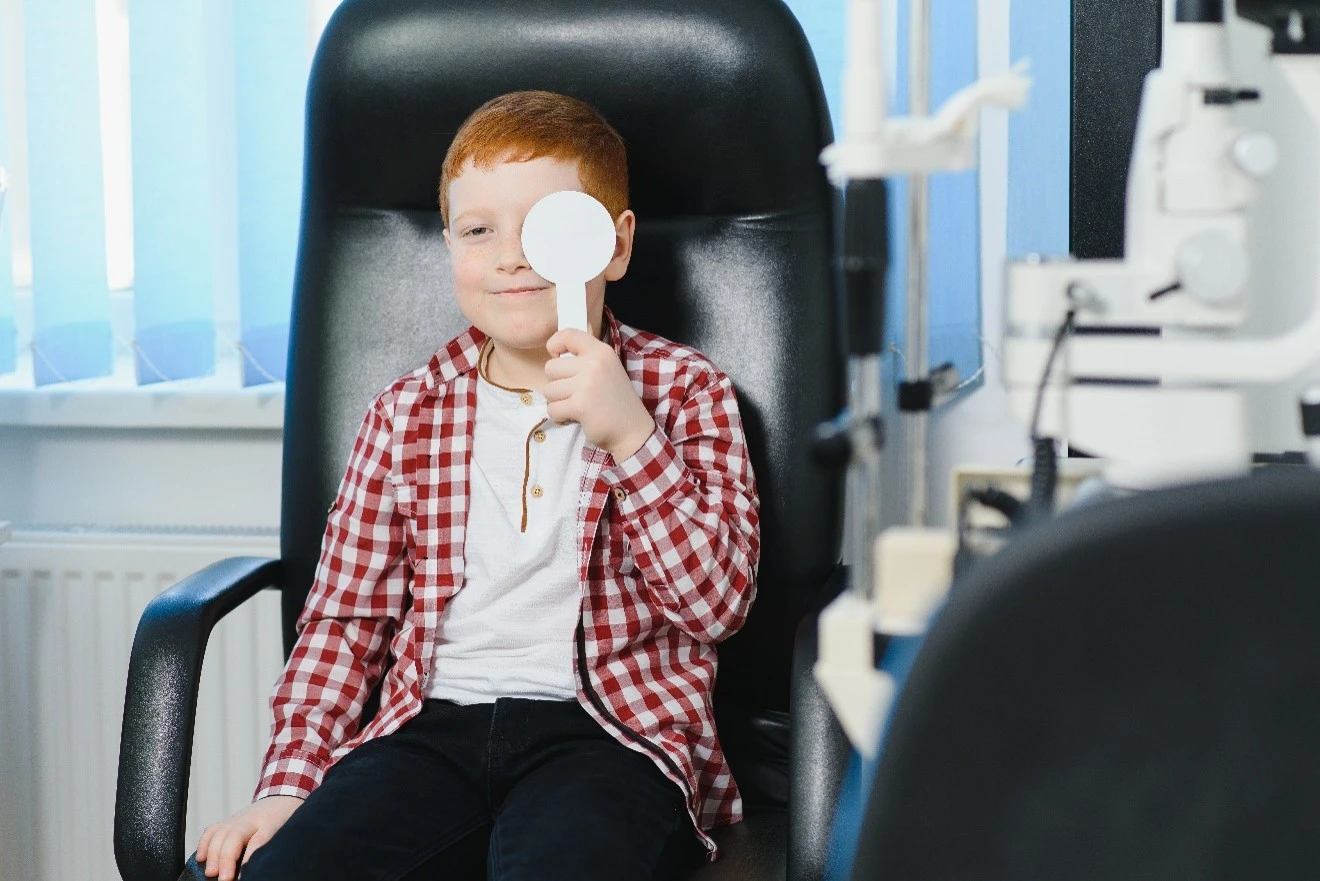
Older children receive exams similar to adult comprehensive exams. The Snellen eye chart with progressively smaller letters measures distance visual acuity. A retinal exam checks the back of the eye, including the retina, optic disk, and blood vessels.
Understanding pupil dilation and eye drops
Dilation enlarges your child’s pupils so the optometrist can see inside the eye clearly. The drops also relax focusing muscles to get an accurate prescription measurement. Your optometrist places one or two drops in each lower eyelid. The drops take approximately 20 to 40 minutes to work. Your child will experience mild stinging for a few seconds, blurry near vision, and light sensitivity. These effects last anywhere from 4 to 24 hours, with children’s eyes staying dilated longer than adults. Bring sunglasses to ease discomfort after the exam.

Why Early Eye Exams Matter: The Connection Between Vision and Learning
Vision drives learning in ways most parents don’t realize. Experts estimate 80% of classroom learning depends on vision. Reading, writing, using computers, and paying attention in class all require the eyes and brain to work together seamlessly.
Visual skills are essential for reading and writing
Reading asks for more than just seeing letters clearly on a chart. Your child needs 17 essential visual skills working together. Some of them are:
- Eye movement control allows both eyes to focus on images or follow a path.
- Saccades are quick, simultaneous movements between focus points, which is essential for reading words across a page.
- Pursuits involve smooth movements between focus points, required for moving between paragraphs or looking from the teacher back to class notes.
- Convergence enables the eyes to turn inward and focus on books or screens.
- Accommodation flexibility lets the eye continuously change focus between near and distant objects, needed for seeing the blackboard clearly and then quickly refocusing on class notes.
How undetected vision problems affect school performance
When vision problems go undetected, children experience skipping words or lines while reading, difficulty focusing on the board, headaches or eye strain after homework, poor handwriting and slow reading speed, and trouble with comprehension despite strong intelligence.
Conditions like convergence insufficiency, amblyopia, or subtle binocular vision disorders interfere with how the eyes track, focus, and process information. Research shows that girls with uncorrected vision had lower academic performance, while boys with uncorrected vision faced similar challenges. What makes detection harder is that children assume everyone sees the world the same way.
Identifying amblyopia (lazy eye) early
Amblyopia affects 2 to 4% of children under age six. The brain favors one eye over the other, causing vision loss in the weaker eye. If detected and treated early, it will often resolve. Treatment becomes more difficult later on, specifically, amblyopia should be treated before a child is 7 or 8 years old for best results. After the vision system fully develops, correcting amblyopia becomes nearly impossible.
Catching myopia and hyperopia before school struggles begin
Hyperopia affects 1 in 7 children and significantly impacts learning, reading, and school performance. Up to 14% of school-age students have farsightedness, but it often goes undetected. Children with hyperopia struggle with eye strain, fatigue, and achieving their potential. Whereas myopia shows obvious signs like squinting, hyperopia hides because young eyes compensate without realizing the extra effort required.
Book Your Child’s Eye Exam in Ottawa
Getting your child’s eyes checked isn’t something to postpone. It’s a simple step that protects their sight and supports their success in school. Booking now means your child gets the visual foundation they need for learning, playing, and developing properly.
Our team at Rideau Centre and St. Laurent Centre understands how to keep young children comfortable during exams. We see infants as young as six months, and the exam works even if your baby can’t talk or identify pictures yet.
Scheduling your child’s first eye exam in Ottawa takes just minutes, and the visit itself is quick and stress-free. You can call either location directly or book your appointment online. We’ll answer any questions you have about what to expect, how long the appointment takes, or whether your infant is ready.
FAQs
Q1. At what age should I schedule my child’s first comprehensive eye exam?
Your child should have their first comprehensive eye exam between 6 and 12 months of age. This early exam checks for nearsightedness, farsightedness, astigmatism, eye movement ability, and eye alignment. Even though your baby can’t read or communicate about their vision, our optometrists use specialized techniques designed specifically for infants to assess their eye health and visual development.
Q2. Does my child need regular eye exams if they haven’t complained about vision problems?
Yes, regular eye exams are essential even without complaints. Children rarely share concerns about their vision because they assume everyone sees the same way they do. Many vision problems in young children show no obvious symptoms, which is why regular exams matter. After their first comprehensive exam at 6 to 12 months, children should have annual eye exams from age 1 through 19.
Q3. Does OHIP cover children’s eye exams?
Children and youth aged 19 or younger are eligible for one basic eye exam every 12 months with a participating Ontario optometrist. OHIP covers the basic exam, but some additional tests and services may not be covered. For example, Optomap imaging, which Rideau Optometric strongly recommends, and contact lens fittings are not covered by OHIP and must be paid for separately. Contact our clinics before your appointment if you have questions about fees or which services are included.
Q4. What warning signs indicate my child needs an eye exam sooner than scheduled?
Watch for signs like frequent eye rubbing or squinting, sitting very close to screens or holding books near their face, difficulty in school or avoiding reading, poor hand-eye coordination, complaints of headaches or eye strain, and eyes appearing misaligned or crossed. These behavioral clues often signal vision problems, as children typically don’t complain directly about blurry vision.
Q5. How does vision affect my child’s learning and school performance?
Approximately 80% of classroom learning depends on vision. Reading, writing, and paying attention in class all require the eyes and brain to work together seamlessly. Undetected vision problems can cause children to skip words while reading, experience difficulty focusing on the board, suffer headaches after homework, and struggle with comprehension despite strong intelligence. Early detection through regular eye exams helps prevent these learning challenges. Call our clinics at Rideau Centre and St. Laurent Centre to get more information.
Leave A Comment
You must be logged in to post a comment.